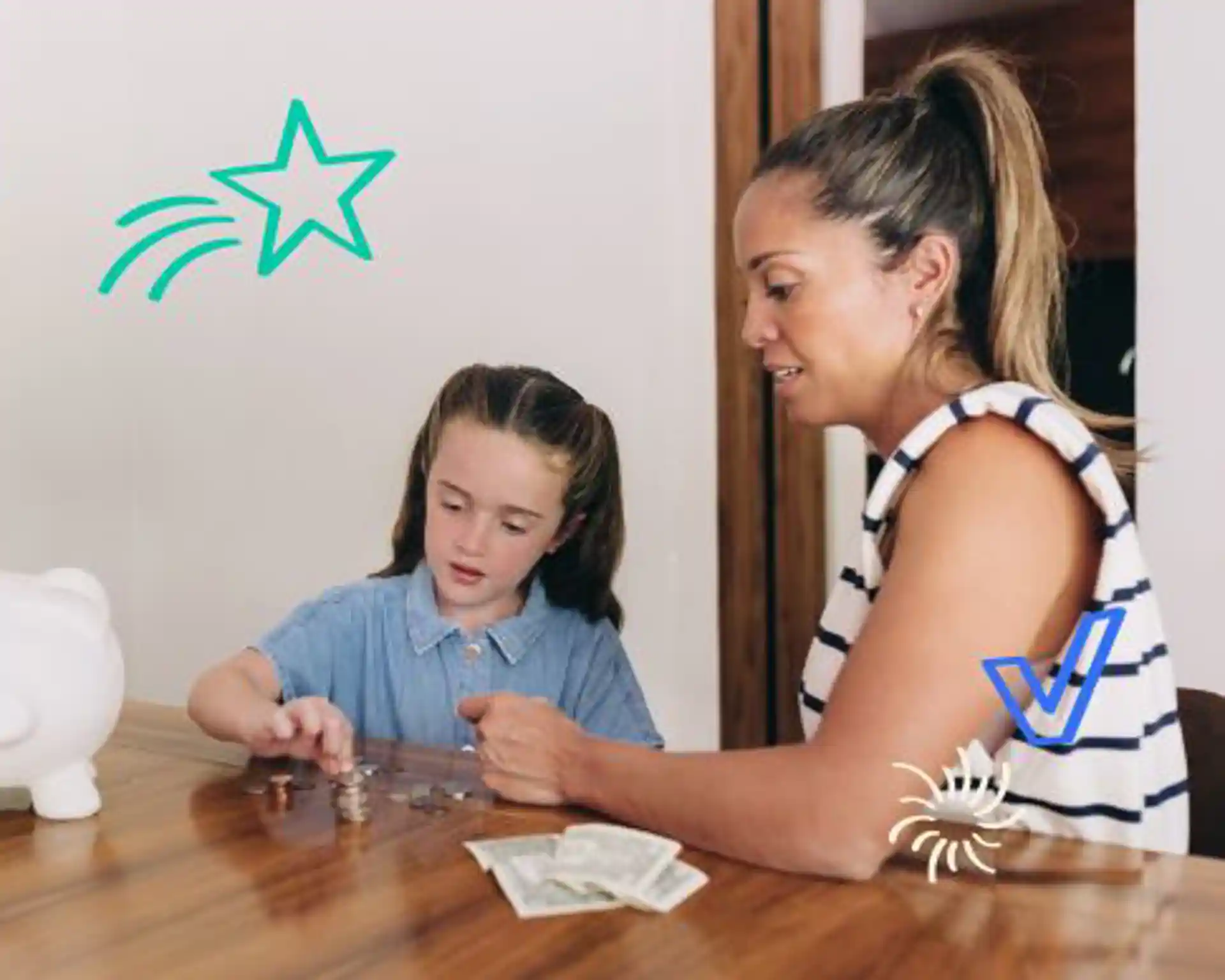
Blog post content
Talking Money with Kids: Tips for Parents during Talk Money Week
As Talk Money Week returns (3-7 November in the UK) to encourage open conversation about finances at home, it’s a perfect time for parents to think about how to coach their children in money skills.
Financial habits begin early, and studies suggest that by age 7 children already start forming money attitudes and behaviours. While schools are increasingly offering resources, parents play a vital role in reinforcing learning at home.
Below are tips, activity ideas, and trusted resources for different child age groups to help parents “do one thing” this Talk Money Week and beyond.
🎯 For ages 4–6 (Early Explorers)
At this early stage, children are building foundational ideas about money: what coins and notes are, the notion of “you need to give something to get something,” and that you can save for something you want.
What to focus on
- Recognising coins, their values, and simple addition/subtraction (e.g. “if you have 5p and spend 2p, how many left?”)
- The difference between “needs vs wants” (you need food, but a toy is a want)
- Introducing the idea of saving for something rather than spending everything at once
- Making money visible (piggy bank, jars)
- Linking actions to money: “If you help with chores, I’ll give you a little” (with clear limits)
Activities & ideas
- Coin hunt: Let your child help you “hunt” for different coins in your purse/wallet and sort them by value
- Pretend shop: Set up a toy shop at home, price items, give them a small amount of “money” and let them buy & get change
- Save, spend, share jars: Use three transparent jars (or envelopes) and when they get pocket money or gifts, help them allocate among the three jars
- Matching games: Card matching where coin + value must match (e.g. “5p” card goes with picture of a bus fare, etc.)
- Storybooks & games: Use simple picture books or board games that include buying/selling or money exchange
Recommended resources
- HSBC UK have interactive lessons and worksheets for ages 3–7 on coin recognition, value, and basic math with money
- Money Heroes (Young Enterprise) offers free resources for ages 3–11 to help parents and teachers teach money basics
- Just Finance Foundation’s Talk Money Week at Home pack includes starter guides and activity ideas for younger children
Tip: Keep it low pressure. The goal is exposure, awareness, and fun. Don’t worry about “perfect answers.”
📘 For ages 7–10 (Developing Confidence)
At this stage kids can understand more abstract ideas: saving for goals, budgeting small amounts, comparing prices, and making tradeoffs.
What to focus on
- Setting short-term and slightly longer goals (e.g. saving for a toy)
- Budgeting small sums (e.g. “if you have £5 to spend and there are three things you want, what do you pick?”)
- Understanding “value for money” (price vs quality)
- Introduction to debit vs credit (in simple terms)
- The role of choice and trade offs
- Early introduction to digital money and the difference between physical and electronic forms
Activities & ideas
- Weekly budget: Give your child a small weekly allowance (real or pretend) and let them plan how to spend, save, or share it
- Shopping challenge: Give them a small budget and ask them to “shop” for snack items (online or in-store) and compare value per unit, cheaper vs more expensive brands
- Price comparison: When you shop, show them two items with different costs/brands and think together about whether the more expensive one is worth it
- Saving towards a goal: If they want a toy, help them set milestones (e.g. “if you save £2 a week, after 5 weeks you’ll have £10”)
- Parent/child “bank”: Let them “deposit” their allowance or gift money and track it (on paper or digitally)
- Discuss adverts: Talk about adverts and why something looks appealing; do they really need it?
Recommended resources
- HSBC has tools aimed at age 7–11 to understand needs/wants, value, and decision-making
- Nationwide’s Money Lessons programme supports children in Key Stages 2 and 3 (ages 7–14) with structured lessons
- Young Enterprise / Young Money: they offer lesson plans, resources, and training to support financial education at home and in school
- Just Finance Foundation’s sample classroom resource packs (for ages 4–11) are adaptable for home use
Tip: Make it real. Whenever possible, connect the activity to money they themselves can control (pocket money, small purchases), rather than hypothetical large sums.
📊 For ages 10–14 (Building Independence & Understanding)
In these years, children and young teens are ready to explore more complex topics: budgeting for larger items, borrowing vs credit, interest, digital payments, scams, and planning.
What to focus on
- Planning for medium-term goals (e.g. a phone, game console)
- Importance of budgeting, tracking income vs expenses
- Understanding interest (on savings and borrowing)
- Introduction to bank accounts, debit cards, and maybe teen-friendly banking tools
- Digital payments, online spending, apps, in-app purchases, and associated risks
- Scams, fraud, identity theft, online safety
- Decision making: wants vs needs, impulse vs thoughtful spending
Activities & ideas
- Personal budget: If they have pocket money, part-time job, or gifts, ask them to forecast their income & expenses over a month and revise if needed
- Savings interest experiment: Show how money grows in a savings account over time (if possible, pick a small, known interest rate and simulate growth)
- “No spend” challenge: For one week, don’t spend on non-essentials. Track how many impulses you resist
- Comparison shopping online: Use multiple sites to find the best deal and show impact of delivery cost, discounts, etc
- Introduce a teen account: If a bank offers a teenager or student account with debit card, let them operate it under guidance (with oversight)
- Discuss scams & digital traps: Show examples of phishing emails, in-app purchases, “loot boxes,” and discuss how to spot risk
- Family financial planning conversation: Invite them (age-appropriately) into a discussion about household budgeting, plans, or decisions you are making (e.g. holiday budget). This gives them exposure to how money decisions are made in real life
Recommended resources
- The Bank of England’s Money and Me programme offers lesson content for ages 5–11 and free resources for older children (Key Stage 2/3)
- Lloyds Bank Academy has financial skills resources aimed at ages 3–16, including budgeting, managing money, digital age issues
- Oak National Academy’s new lessons (for English schools) include modules for pupils aged 5–16 on online spending, in-app purchases and identifying scams
- Just Finance Foundation’s Talk Money Week / At Home resources (for a range of ages) are helpful for planning home-based conversations and activities
- MyBnk (UK charity) offers workshops and resources for 7–25 year olds focusing on real-world money skills
Tip: Gradually shift responsibility to them — allow them real control (within limits), make mistakes (in safe amounts), and discuss consequences.
✅ A “Do One Thing” Prompt for Talk Money Week
To help parents get started this Talk Money Week, here’s one simple idea you can commit to:
Pick one age-appropriate “money conversation or activity” this week e.g. explore a “save/spend/share jar,” plan a small budget with your child, or walk through the grocery shelf comparing value. Use it as a springboard for further discussions.
You don’t need to be a money expert to begin. Be open, curious, and willing to learn alongside your child. The goal is to develop their confidence, not perfection.
Tips & Best Practices for Parents
Lead by example
Children observe how you use money, spend, save, budget, and talk about it. If you hide or avoid money conversations, it signals it’s taboo.
Be honest & age-appropriate
You don’t need to share every detail of your finances, but you can explain general tradeoffs (e.g. “We can’t afford X right now, so we choose Y instead”).
Encourage curiosity, not judgment
If your child asks about something you can’t immediately explain, explore it together instead of shutting it down.
Allow safe “mistakes”
Let them spend some money (within limits) and experience that running out of money means you can’t buy more. That builds real understanding.
Make it ongoing
Occasional conversations help, but regular check-ins (weekly, monthly) reinforce that money is part of life and learning.
Use trusted resources and avoid pushing overly commercial products
When you introduce apps, teen accounts, etc., vet them carefully for fees, privacy, and suitability.
Talk about value, not just price
Encourage them to think about what they are getting for what they pay (durability, enjoyment, resale, etc.).
Start the money conversation today — small steps now can build a lifetime of confidence. Happy Talk Money Week!